

Shipping an electric car is not the same as moving a gas car. It needs trained carriers, FMCSA and DOT safety rules, and extra care for lithium-ion batteries. Nova Auto Transport makes EV shipping easy with certified drivers, $1 million insurance, and real-time tracking. From Tesla to Rivian, Nova ships nationwide using open or enclosed carriers based on your budget and vehicle type. The guide covers everything, costs, routes, timelines, and safety laws, so you can ship your electric car across the U.S. safely, quickly, and without stress.
Introduction
Electric cars are now everywhere in America. From Tesla to Rivian, Lucid, and Nissan, thousands of electric vehicles (EVs) are moving across states every single day. Families are relocating, students are moving to new cities, and dealerships are sending cars to customers nationwide. But shipping an electric car is not the same as moving a regular gas car. It needs special care, trained carriers, and rules that meet U.S. DOT and FMCSA standards.
Electric vehicles have lithium-ion batteries that are heavy and powerful. They make the car almost 25% heavier than normal ones. That extra weight changes how trucks carry them, how they are strapped, and even how they are insured. The battery also needs temperature control and safety checks before moving long distances.
Due to such specifics, not all the companies are prepared to deal with EV transportation. It is where Nova Auto Transport is different. Nova has been years of operation delivering electric and hybrid vehicles such as Tesla Model 3, Ford Mustang Mach-E, and Rivian R1T to the nation without any accidents.
Having all FMCSA-certified carriers, 1 million insurance and trained EV handlers, Nova ensures that every electric powered car is transported through safe and legal standards and procedures. Here in the guide we are going to tell you all the details, the laws and safety measures, prices, routes and schedules, so that you can have a complete picture of what to expect when you ship out your EV in 2025.
How EV Shipping Differs from Standard Auto Transport
Many believe that the process of shipping an electric car is similar to shipping a regular car. But that’s not true. EVs due to their lithium-ion batteries have special rules under the Department of Transportation (DOT) and the Federal Motor Carrier Safety Administration (FMCSA).
Such batteries are regarded as dangerous substances under regulations such as IMDG and UN3480. It implies that all EV carriers should be guided by stringent regulations of safety, such as the battery isolation, loading the vehicle, and emergency measures taken in the event of overheating.
Normal carriers that transport gas cars might not be certified to transport EVs. They require special training, fire suppression equipment and isolation pads to curb the occurrence of thermal runaway (battery overheating).
Here’s a simple comparison:
| Feature | Standard Car Shipping | Electric Vehicle Shipping |
| Weight | Normal | Heavier due to battery |
| Battery Type | None / Lead acid | Lithium-ion |
| Regulation | Standard DOT rules | DOT + Hazardous Material Rules |
| Carrier Type | Standard hauler | Certified EV hauler |
| Insurance | Up to $250k | Up to $1M (Nova) |
EVs also need battery management systems (BMS) to stay active during shipping. If the BMS isn’t managed right, it could drain or trigger alerts. Nova’s drivers know how to monitor this safely using approved EV protocols.
In short, the biggest differences come from battery weight, fire safety, and special equipment. That’s why it’s important to book a company that’s already experienced in EV-specific shipping, not just a random car hauler.
How to Prepare Your Electric Vehicle for Shipping
Shipping your EV the right way starts before the truck even arrives. Preparing it properly can save time, protect the car, and meet the FMCSA inspection rules.
Here’s a simple checklist for your EV shipping prep:
- Charge Battery to 25–50%
Keep it half-charged. Full batteries become hotter and low batteries may even close during transportation. Most carriers such as Nova suggest 30-40%.
- Turn Off Autopilot and Alarm Systems
In case your EV has Tesla Autopilot or other self drive systems, turn them off. It makes the car not to respond to the movement on the trailer. Also switch off alarms to prevent the sound or notifications on the trip.
- Secure Charging Cables and Accessories
Place your adapters and charger in your trunk. Safe wrap them so that they don’t move.
- Inspect and Document Vehicle Condition
Clean the car and shoot pictures on all sides. Note any present scratches or dents. To determine the condition of the car at the point of delivery and before its delivery, Nova relies on a Bill of Lading.
- Tell the Driver About Special Features
In case your car has a special charge port, air suspension, or battery mode, demonstrate it to the driver. EVs behave in different ways and a brief discussion will allow the carrier to cope with it.
- Lock the Car but Keep Spare Keys Ready
The driver might require access to do loading and unloading. Never forget to leave a spare key set.
These are some of the steps that ensure that your car is safe and does not result in any violation of the transport laws. The EV staff at Nova also conducts an inspection of the shipment as per the DOT rules and thus nothing is overlooked before loading.
Open vs Enclosed Transport for Electric Vehicles
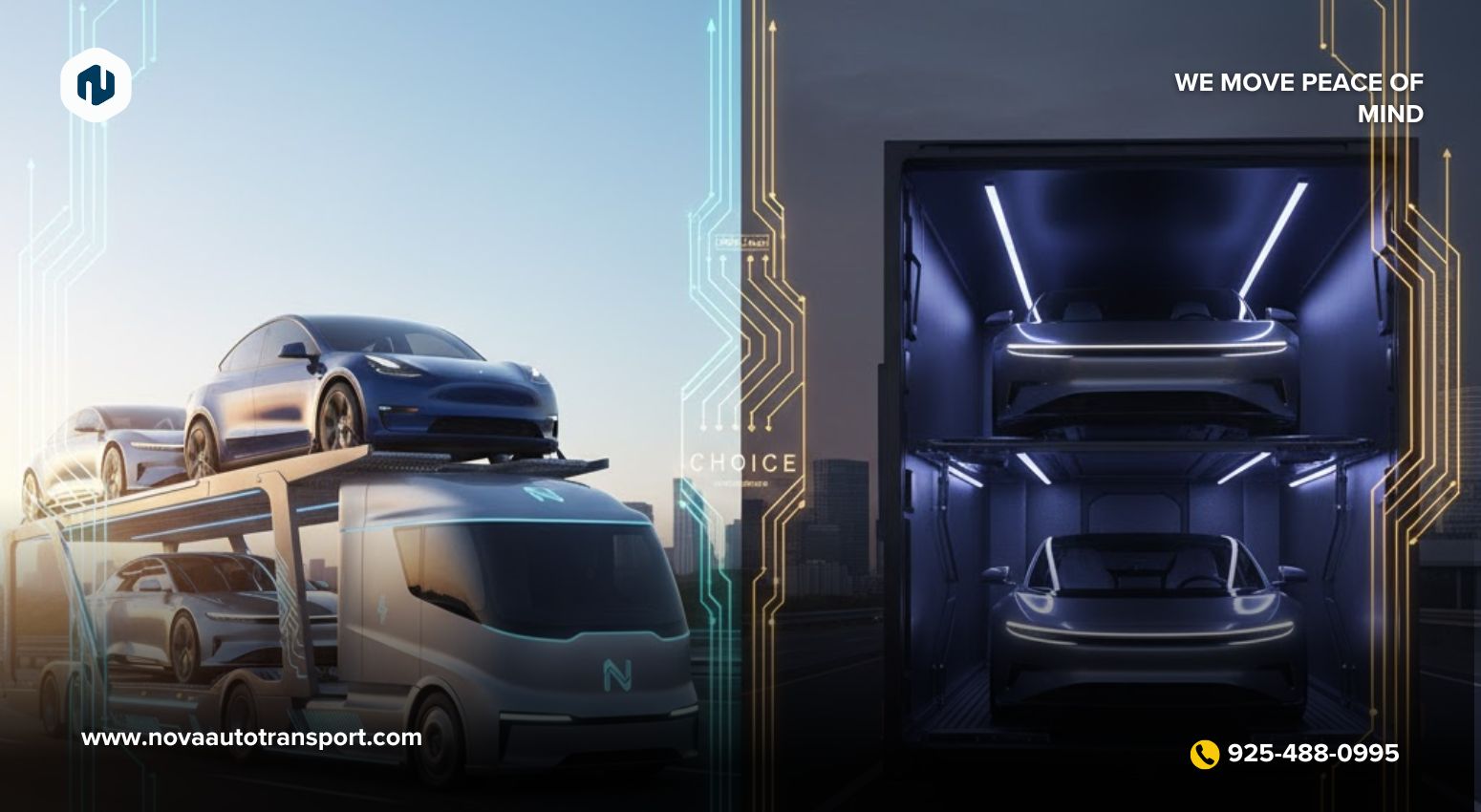
Now comes one of the biggest choices, how to ship your EV. You can go with open transport or enclosed transport.
Open Transport for EVs
Open transport is cheaper and widely available. It uses big trailers that carry 7–10 cars together. Your EV stays safe but is open to the weather. For most standard electric vehicles like a Nissan Leaf or Chevy Bolt, this option works great.
Pros:
- Lower cost (usually 30–40% cheaper)
- More carriers available
- Faster pickup times
Cons:
- Exposed to dust, rain, or sun
- Not ideal for luxury EVs
Enclosed Transport for EVs
This method uses closed trailers, like a garage on wheels. It’s safer, private, and fully covered from weather and road dirt. It’s the top choice for Tesla Model X Plaid, Lucid Air, or Rivian R1T owners.
Pros:
- Maximum protection from weather
- Higher insurance (up to $1 million with Nova)
- Suitable for luxury or custom EVs
Cons:
- Higher price (40–60% more)
- Slightly fewer carriers nationwide
Here’s a quick price comparison:
| Distance | Open Transport | Enclosed Transport |
| 500 miles | $650–$850 | $950–$1,300 |
| 1,000 miles | $850–$1,100 | $1,300–$1,700 |
| 2,000 miles | $1,200–$1,500 | $1,800–$2,400 |
| Cross-country (CA → FL) | $1,400–$1,800 | $2,200–$2,900 |
Nova offers both options. Most EVs are shipped open because it’s reliable and affordable. But for high-end or custom models, enclosed shipping gives total peace of mind.
EV Shipping Cost Breakdown (2025 Data)
At what price does it cost to transport an electric car in 2025? The solution is dependent on the distance, the type of vehicles, and the demand on the route.
The following are the primary factors, which influence EV shipping prices:
- Distance and Route
The further the journey the more expensive it will be. However, per-mile charges decrease as distance increases. As an illustration, 500 miles can cost about 1.50 per mile whereas 2000 miles can reduce to 0.75 per mile.
- Vehicle Weight and Size
EVs are heavier due to their lithium-ion batteries. The weight of a Tesla Model Y is approximately 4,400 lbs, which matches 3,200 lbs on Toyota Camry. This will put an additional of about $100-250 on your quote.
- Type of Transport
The enclosed carriers are also priced at 40-60 percent of the open carriers due to the fact that the enclosed carriers carry the fewest vehicles and have premium insurance covers.
- Seasonal Demand
The prices in summer are more due to the relocations and dealership volume. The cheapest season to ship is winter and early spring.
- Pickup and Drop-off Locations
The cheapest ones are big cities such as Los Angeles, Dallas, and Miami, as they operate on major routes. Small towns or rural locations may increase the cost by up to $150 -200.
The following are real-life examples of Nova Auto Transport EV routes and prices (2125 average):
| Route | Distance | Type | Avg Price (Open) | Avg Price (Enclosed) | Transit Time |
| California → Florida | 2,700 mi | Tesla Model Y | $1,600 | $2,400 | 7–9 days |
| Texas → New York | 1,700 mi | Rivian R1T | $1,300 | $1,950 | 5–7 days |
| Arizona → Illinois | 1,500 mi | Nissan Leaf | $1,150 | $1,700 | 4–6 days |
| Washington → Colorado | 1,200 mi | Lucid Air | $1,000 | $1,550 | 3–5 days |
Nova’s quotes always include door-to-door delivery, full insurance, and real-time tracking. The price you see is the final price, no surprise fees or last-minute hikes.
Safety and Compliance Protocols in EV Transport
Safety rules are very strict for moving electric vehicles in the United States. The FMCSA (Federal Motor Carrier Safety Administration) and the USDOT (Department of Transportation) regulate every company that carries EVs. Since EVs use lithium-ion batteries, they must follow guidelines similar to hazardous materials transport.
Every EV carrier needs a license under DOT rules and must know how to handle batteries safely. Lithium-ion packs are sensitive to temperature and can catch fire if damaged or charged wrong. Carriers use fire suppression systems, temperature sensors, and battery isolation procedures to keep everything safe.
Nova Auto Transport only accepts carriers that comply with the requirements of FMCSA and DOT. Their motorists are trained in EV safety and wear safety equipment such as insulated mats and ground straps. The carriers of Nova also set the weight of the trucks right to ensure that the additional weight of the battery of EVs does not strain and make the truck imbalanced during transit.
Insurance matters too. All EVs sold with Nova include a $1 million insurance to cover the battery damage, accidents, or as a result of handling error. This will not only ensure that the process is compliant but it will also leave the owner stress free.
Cross-Country and State-to-State EV Shipping Examples
Electric cars are exported throughout the United States on a daily basis. The majority of journeys occur between megalopolises that have EVs on board such as California, Texas, New York, and Florida.
In 2025, Nova Auto Transport takes the following real routes and their respective distances:
| Route | Vehicle | Type of Carrier | Distance | Average Cost | Delivery Time |
| California → Florida | Tesla Model Y | Enclosed | 2,700 miles | $2,400 | 7–9 days |
| Texas → New York | Rivian R1T | Open | 1,700 miles | $1,350 | 5–6 days |
| Arizona → Illinois | Nissan Leaf | Open | 1,500 miles | $1,100 | 4–5 days |
| Washington → Colorado | Lucid Air | Enclosed | 1,200 miles | $1,550 | 3–4 days |
These routes are some of the busiest EV corridors in America. The trucks travel across major highways like I-10, I-40, and I-70, depending on season and traffic.
EV shipping time is usually the same as gas vehicles, though enclosed carriers may take a little longer because of fewer trucks available. Nova also offers expedited shipping for urgent deliveries, cutting the time by 1–2 days for an extra cost of about $150–$300.
Customers can track their cars in real time through Nova’s online portal. Updates are sent at every stage, pickup, route progress, and delivery confirmation.
Common Challenges When Shipping EVs (and How to Avoid Them)
Even though electric car shipping is getting easier, there are still a few challenges that people face if they pick the wrong company.
Battery Drain During Transit
When an EV is completely charged, or with low charge, it can lose battery capacity when transported over long distances. This can best be solved by not changing the battery above 25-50 per cent, and Nova drivers will always check their batteries before loading.
Carrier Inexperience
There are companies that receive EV shipments without trained drivers. This may cause bad loading, bad handling of the battery or even raising of alarms. Make sure to demand EV handling certification or FMCSA license prior to booking.
Improper Battery Handling
Batteries made of lithium-ions require isolation mats or foam padding when being shipped. Without it, it can cause the damage of the pack with the vibrations. Nova employs carriers with trailers that are EV-friendly, and designed with additional battery weight and safety.
Weather-Related Risks
Battery performance may be influenced by hot or cold weather. Shipping is enclosed against heat alterations. Nova also recommends scheduling shipments on gentle months such as March or October where there is less turbulence on the way.
Thermal Runaway Prevention
“Thermal runaway” means the battery overheats and causes a chain reaction. Nova carriers have fire suppression kits and isolation zones to prevent this, as required under DOT EV Safety Standards (2025 revision).
Why Nova Auto Transport is the Best Choice for Electric Vehicle Shipping
Nova Auto Transport is one of the few U.S. companies that specialize in electric and hybrid car transport nationwide. They are fully FMCSA-certified and follow DOT compliance for lithium-ion battery shipping.
Nova has experience shipping cars like Tesla Model S, Rivian R1S, Lucid Air, and Polestar 2. Their drivers are trained for EV loading, know how to isolate power systems, and follow inspection checklists before every shipment.
Here’s why people choose Nova for their EV:
- Full FMCSA and DOT Certification: All carriers are licensed and verified.
- $1 Million Insurance: Covers battery, handling, and transport damages.
- Real-Time Tracking: See your EV move from pickup to drop-off.
- Door-to-Door Delivery: The driver picks up from your home or office and delivers right to the destination.
- Transparent Quotes: No hidden fees, no deposit scams.
- Experienced EV Carriers: Nova only works with carriers trained in EV handling and safety.
Nova also offers expedited enclosed transport for high-end EVs. This service gives faster pickup, temperature control, and private shipping for premium models.
With offices covering California, Texas, and Florida, Nova’s network reaches all 48 states. Their customer support runs 24/7, helping clients plan routes, understand pricing, and follow FMCSA rules without confusion.
FAQs – Electric Vehicle Shipping (2025 Update)
General EV Shipping
What is the safest way to ship an electric vehicle?
An electric car is safest when transported on an enclosed car. It preserves the car and protects it against foul weather, dirt or road debris. More insurance is also provided by enclosed carriers. Nova Auto Transport has certified drivers of FMCSA, who understand how to handle EV batteries and how to ensure their safety on the way.
How much does it cost to ship an EV across the country?
It relies on distance, size and type of transportation. The average cost of open carrier EV shipping ranges between 1,400 to 1,800, whereas the average cost of enclosed shipping ranges between 2,200 to 2,900 across the coast-to-coast routes, such as California to Florida. Nova Auto transport provides real-time pricing hence you will never miss the correct price when booking.
Is enclosed transport necessary for electric cars?
Not always. In case you have a common EV such as Nissan Leaf or Chevy Bolt, open transport is alright. But when transporting such models as Tesla Model X, the Lucid Air, or Rivian R1T, enclosed shipping is preferable as it provides maximum protection and privacy in transportation.
Can I ship my EV if it’s not running?
Yes, you can. Carmen with winches and hydraulic lifts can be used to ship non-running EVs. It can be priced excessively at 150-300 extra as it requires special loading gear. Drivers at Nova Auto transport have been trained to deal with non-running or partially charged EVs.
Battery & Safety
Should I fully charge my EV before shipping?
No, never fully charge it. The battery should be 25–50% charged before transport. A full battery can get too hot during long travel, and a very low charge can shut down the system. Nova’s drivers check this level during pickup.
How are lithium-ion batteries handled during transport?
Lithium-ion batteries are treated like regulated hazardous materials. Carriers follow DOT and FMCSA rules, using insulated mats and battery isolation pads. Nova’s EV carriers have fire suppression systems and temperature control setups for long-distance trips.
Is there a risk of fire when shipping an EV?
The risk is very low when handled properly. Nova uses only FMCSA-approved carriers with thermal monitoring systems. Drivers are trained in battery safety and have emergency equipment onboard. Every vehicle also gets inspected before loading to check for leaks or electrical faults.
Do EV shipments require special insurance?
Yes. Because of the high value and lithium-ion batteries, EVs need extended insurance coverage. Nova Auto Transport includes up to $1 million in coverage for all enclosed EV shipments, which protects against damage during loading, transit, or unloading.
Brand-Specific Questions
How do I ship a Tesla Model 3 or Model Y safely?
Always disable Tesla Autopilot, alarms, and sentry mode before pickup. Keep the charge around 40%, and give the driver the charging cable. Nova’s Tesla-trained drivers use soft straps and wheel nets to prevent scratches and pressure marks on the wheels.
Are Rivian and Lucid vehicles shipped differently?
Yes, a bit. Rivian trucks are heavier and need special low-angle ramps to load safely. Lucid cars have delicate body panels, so they usually go in enclosed carriers. Nova Auto Transport has handled both models many times and knows the right procedures for each brand.
Does Nova ship BYD or imported EVs from China?
Yes, Nova ships all EV brands, including BYD, NIO, and other imported electric cars. They handle both port deliveries and inland transport under customs-cleared documentation. Every shipment follows DOT import vehicle transport rules to make sure it’s fully compliant.
Process & Timing
How long does it take to ship an EV from California to Florida?
Usually between 7 to 9 days depending on weather and season. If you use expedited shipping, it can take 5 to 6 days. Nova’s route runs along I-10 and I-40, two of the busiest EV corridors in the country.
What’s the difference between open and enclosed EV transport?
Open carriers are cheaper and great for standard EVs, but they leave the car exposed. Enclosed carriers are more expensive but protect against rain, wind, and road debris. They’re recommended for luxury or new EVs.
How can I track my EV shipment in real time?
Nova Auto Transport gives you a tracking link as soon as your EV is on the truck. You can see the route, carrier details, and estimated delivery time anytime. Nova’s dispatch team also sends updates by text or email during transit.
What documents do I need to ship my electric car?
You’ll need:
- A valid ID (driver’s license or passport)
- The vehicle registration
- Proof of insurance
- And the Bill of Lading, which you’ll sign during pickup and delivery
These documents are required under FMCSA and DOT vehicle transport rules for verification. Nova’s team helps customers with every step, so no paperwork is missed.
Conclusion: Simplify Your EV Shipping with Nova Auto Transport
Electric car shipping might sound complex, but with the right company, it’s smooth and safe. Nova Auto Transport knows EVs, from Tesla’s Autopilot systems to Rivian’s massive battery packs. Their carriers meet all FMCSA and DOT safety laws, follow proper battery isolation standards, and deliver coast-to-coast coverage across the U.S.
With full insurance, real tracking, and fair prices, Nova helps you ship your electric vehicle without stress. Whether you’re moving across states, buying a car online, or sending one to family, Nova keeps the process simple, legal, and secure.
Get your free EV shipping quote today at Nova Auto Transport, and see why thousands trust Nova for safe, compliant, and affordable electric vehicle delivery in 2025.


