

Auto Transport Broker vs Carrier – What’s the Difference? (2025 Guide)
Summary: What This Guide Covers
The car shipping world can be confusing. You go online for a quote, and suddenly ten companies start calling – all saying they’re the “best.” But are they actual carriers with trucks, or are they just brokers acting as the middlemen? In this guide, you’ll finally understand what’s really going on behind those auto transport quotes.
We will describe the distinctions between brokers and carriers, how they operate, what laws are applicable to them, and when one of them suits you better in your route, price, and time. You will get to know about FMCSA (Federal Motor Carrier Safety Administration) regulations, insurance requirements, and the reason some of the cheap quotes offered online make you vulnerable.
You’ll also discover how Nova Auto Transport stands out – not as a random broker but as a licensed FMCSA-verified hybrid, meaning they are both a registered broker and a direct carrier partner. That means no middlemen, no hidden fees, and no fake quotes.
By the end of this guide, you’ll know:
- Who really ships your car
- How to verify a company’s credentials
- How pricing works between brokers and carriers
- How Nova combines transparency and flexibility for every customer
This article is meant for anyone planning to ship their vehicle in 2025, especially those in California, Texas, Florida, and New York, where seasonal demand and route pricing change fast.
Understanding the Basics of Auto Transport
How Vehicle Shipping Works
Auto transport in the U.S. follows a simple but structured process:
Quote to Dispatch to Pickup to Delivery.
When a customer orders a quote, the rate is calculated by the company depending on the distance, the kind of vehicle, the level of popularity of the routes, and time of the year. After the buyer makes a confirmation, the delivery is made – i.e., a carrier (truck operator) takes a job. The driver then picks up the car and puts it in a truck (open or enclosed) and allocates it to the end destination.
In the midst of all this, you may have two types of companies a broker or carrier with or without the other. The carrier is assigned and found by the broker; he or she physically transports your car.
Roles within the Transport Process:
- Customer: It is the owner of a vehicle who orders the transport.
- Broker: This is the company to whom the logistics are organized, insurance checked, and a carrier chosen.
- Carrier: This is the trucking company that owns and moves the trailer in which the vehicle is being transported.
The reason why many people fail to differentiate between brokers and carriers is that they both give quotes, and their name includes auto transport. But one has trucks – the other has not.
How the Industry Evolved
Before 2010, most auto transporters were small local carriers. With the rise of the internet, online brokers started dominating the industry. They connect customers to a large network of carriers using Central Dispatch, the main national load board regulated by the FMCSA.
This model helped customers get faster pickups and better rates – but it also opened doors for unlicensed brokers who use lowball tactics to grab deposits and vanish.
That’s why understanding the difference between the two isn’t just helpful – it protects you legally and financially.
What Is an Auto Transport Carrier? (The Direct Movers)
Definition: Who Are Carriers
A carrier is a business that owns physical trucks and trailers that are utilized in transporting vehicles. Those companies can also be referred to as auto haulers, owner-operators, or motor carriers. They are those that go on the highways in a stacked manner, with a number between 7 and 10 vehicles per truck.
The carriers are registered by the U.S. Department of Transportation (USDOT), and they possess an MC (Motor Carrier) number issued by FMCSA. It is their duty to physically touch your car and deliver it to you.
How Carriers Operate
Carriers deal either with customers or brokers. They plan pickups, conduct inspections of vehicles, load and unload, as well as manage driver hours according to Hours of Service (HOS) regulations of FMCSA.
An average long-haul trucker is going to cover 400-600 miles in a day, subject to weather conditions and legal driving restrictions (11 hours per day usually is the maximum). They spend between $250,000–400,000 on their trucks, hence they are ready to take guaranteed loads with the brokers instead of trying to attract new clients daily.
Carriers tend to specialise in particular routes – such as:
- Routes along the West coast (California to Arizona to Nevada).
- East Coast routes (New York to Florida to Georgia).
- Cross-country lanes (Los Angeles to Dallas to Miami)
Smaller carriers may carry two or three trucks only, which implies that they will have few schedules and capacity during the peak season.
Pros of Working with a Carrier
- Direct contact with the driver: You speak directly with the person handling your vehicle.
- No middleman fees: You pay the company that owns the truck.
- Simple coordination: Perfect if your route matches their lane.
- Faster dispatch in local routes: Less paperwork and waiting time.
Cons of Working with a Carrier
- Limited routes and coverage: If your pickup or delivery city is off their route, you’ll wait longer.
- Less customer service: Drivers are on the road, not at a desk.
- Fewer options: Only one trailer type or schedule.
- Harder to find online: Most small carriers don’t run websites or online quotes
Example: If you live in San Jose, CA, and the carrier you find only runs LA-to-Phoenix routes, your car might sit for days until the driver is heading north again.
Carriers are excellent for customers along popular highways, but not always the best for flexible timelines.
What Is an Auto Transport Broker? (The Logistics Connector)
Definition: The Middleman That Makes It Move
Neither does a broker own any trucks or trailers. They are the ones who are supposed to connect the customers with the carriers that will be available. They deal with scheduling, paperwork, insurance verification, and price negotiation.
Imagine that brokers are automobile travel agents. They make no flight; they are purchasers of a flight. However, in this instance, the flight is the shipping of your car by a certified transport company truck.
FMCSA licenses and regulates brokers as well. To legally practice in the U.S., they need to have an active Broker Authority (MC number) and a bond in the amount of $75,000. This bond is to cover consumers in the event of a carrier not being paid by a broker or when running a fraudulent business.
How Brokers Work
When you send a quote, a broker uploads your shipping information – which includes route, type of vehicle, and pick up date – to a national dispatch service, such as Central Dispatch. The carriers visit the board, check out your offer, and bid on the job.
The broker, in turn, confirms the optimal match in terms of speed, route, and price. After a carrier has been allocated, you are sent the Bill of Lading (BOL), driver details, and tracking.
In most instances, brokers handle 90% of the shipping in the United States. At any given moment, they can have immediate access to 20,000+ carriers, which a small hauler is not able to provide.
Pros of Working with a Broker
- Faster availability: Brokers can find a truck even during busy seasons.
- More route coverage: Coast-to-coast or remote cities are easier to reach.
- Customer service teams: Brokers handle communication between you and the driver.
- Flexible scheduling: Access to multiple carriers means better timing.
Cons of Working with a Broker
- No physical trucks: They depend on carriers to move your car.
- Lowball quotes: Some unethical brokers offer unreal prices, then increase later (bait-and-switch).
- Hidden fees: Fuel surcharges, storage, or cancellation fees might appear later.
- Less control: They can’t guarantee which driver you’ll get unless they vet carefully.
A big warning sign is a broker that demands a non-refundable deposit before assigning a carrier. Legit brokers, like Nova, only charge after confirming a verified truck with insurance.
How to Verify Whether a Company Is a Broker or Carrier
Use the FMCSA Company Snapshot Tool
The fastest and safest way to check a company’s legitimacy is through the Federal Motor Carrier Safety Administration’s Company Snapshot Tool.
Just type in the company’s name or USDOT/MC number, and you’ll see details like:
- Entity Type: Broker, Carrier, or Broker/Carrier
- Operating Status: Active or Inactive
- Insurance Type and Policy Number
- Safety Rating and Complaint Record
If a company hides its MC number or says it’s “not needed,” walk away. Every legal transport business must show this number on its website and paperwork.
Check for Licensing and Bonding
According to the 49 CFR Part 371 of Federal law, brokers must carry a surety bond of $75000. This safeguards both the consumers and carriers against fraud. In case a broker defaults on paying a carrier or defaults without giving notice, the bond is able to compensate for the losses.
Carriers, conversely, need to be insured in Cargo and Liability – typically $750,000 minimum according to federal regulations, and most premium carriers have a policy as high as $1 million.
Verify Complaint History
The FMCSA site displays the complaint information and inspection outcomes too. A company that is denied by several complaints on the non-delivery or change of price after booking is a probable risky broker. It is also available to check the Better Business Bureau (BBB) to see what other people say and the rating.
Look for Signs of Transparency
- Real address listed on Google Maps
- Phone number with live human support
- Quotes that include insurance and carrier details
- No demand for large upfront deposits
Nova Auto Transport, for example, lists its MC #1699248 and DOT #4347175 publicly and encourages customers to verify them. They operate under full FMCSA authority as both broker and carrier, ensuring complete transparency.
Real Example – Checking a Broker vs Carrier
Let’s say you see two companies online:
- Company A: Offers $650 for Los Angeles to Dallas, but no MC number.
- Company B: Offers $825 and lists both MC and DOT numbers.
When you check FMCSA, Company A shows “Inactive” status, while Company B is an “Active Broker/Carrier.” The second one might look slightly pricier, but it’s legal, insured, and accountable – which means your car won’t vanish into thin air.
The Hybrid Model: Broker + Carrier (Best of Both Worlds)
What Is the Hybrid Model?
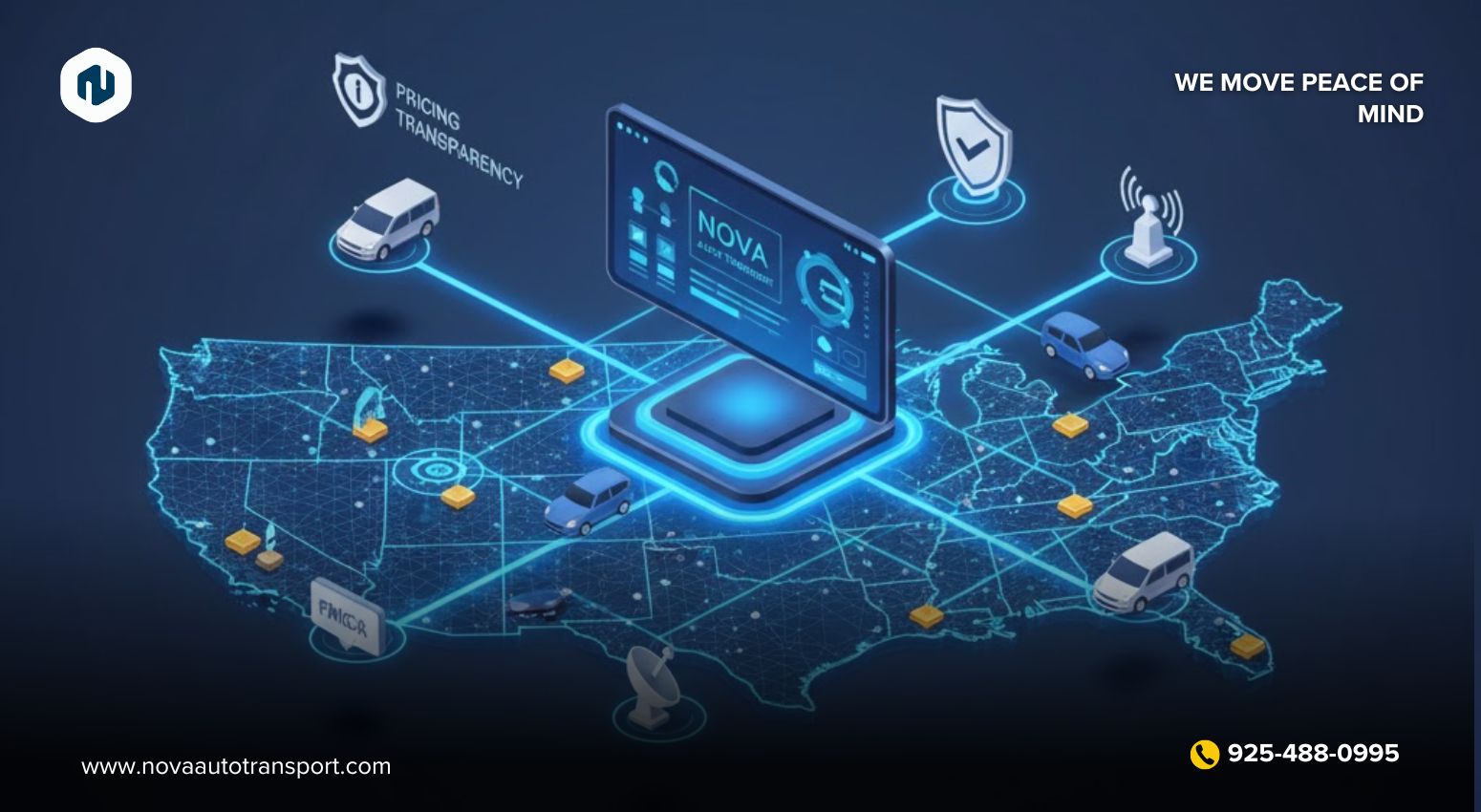
Most leading auto transport companies in 2025 do not simply play the role of brokers or carriers – they do both. It is the so-called model of the broker-carrier hybrid, which provides more flexibility, quicker schedules, and real-time assistance to the customers.
A hybrid company possesses FMCSA authority two times- Broker and Carrier. It implied that they can license out trucks and can delegate freight to other certified carriers in case their own fleet is occupied. Therefore, they can deliver any shipment in the country without any delays, as opposed to being restricted by any route or availability.
One of the largest customer frustrations is also addressed with the help of this model: waiting until a truck comes to your neighborhood. Nova Auto Transport hires its own trucks and partnered carriers; thus, when one of the routes is full, the other carrier belonging to the confirmed network takes its place.
Why It Works Better for Customers
Because Nova acts as both broker and carrier, your car never gets lost in the shuffle. Everything happens under one umbrella:
- You get a locked-in quote directly from Nova.
- The company assigns a verified, insured truck.
- You receive constant tracking updates and contact with a real dispatcher.
If you book during a busy season (like June–August), Nova doesn’t need to reject you or delay pickup like a small independent carrier might. They can route your shipment instantly to one of 20,000+ partner trucks across the U.S., all of which are FMCSA-insured and personally vetted.
Legal Protection and Insurance
According to FMCSA regulation 49 CFR 387, every broker-carrier must maintain both broker bond and cargo liability coverage. Nova’s coverage exceeds federal requirements:
- $1,000,000 full-value insurance per shipment
- $75,000 surety bond for broker protection
- Active MC #1699248 and USDOT #4347175
That means if anything ever goes wrong (which is rare), your shipment is legally and financially protected by two separate federal guarantees.
Nova Auto Transport Advantage
- FMCSA Dual Licensing: Nova holds both Broker and Carrier authority.
- Nationwide Fleet Access: Over 20,000+ enclosed and open trucks available.
- Locked-In Pricing: No changes after confirmation – rate guaranteed.
- Transparent Dispatch: Customers know exactly who the driver is and when they’ll arrive.
- Full Insurance Coverage: $1M cargo policy, not partial coverage like many brokers.
In short, the hybrid model is the best of both worlds: the coverage of a broker, the control of a carrier, and the accountability of both.
Common Misconceptions About Brokers and Carriers
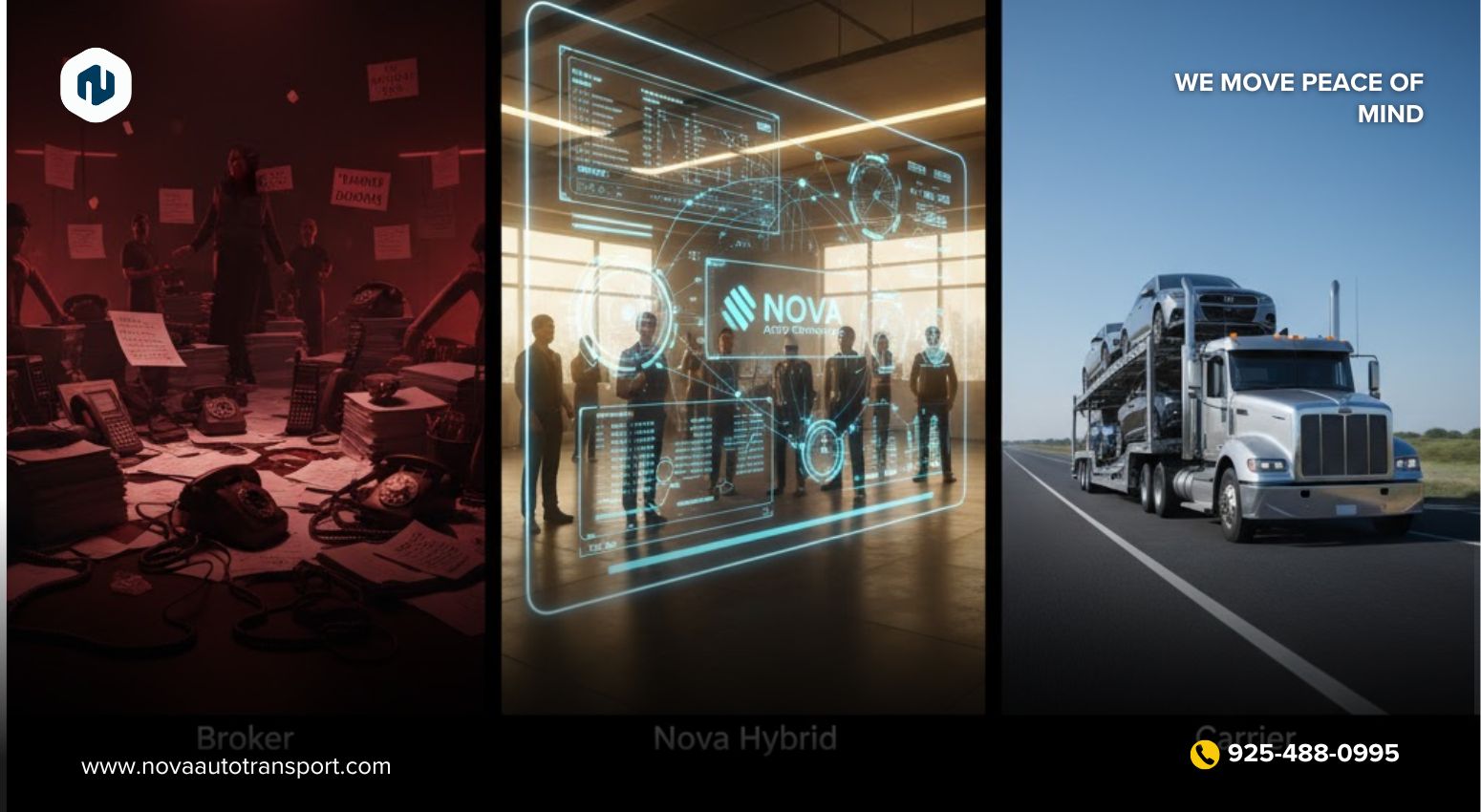
The auto shipping industry is full of myths. People read something online or hear a bad story and assume all brokers or all carriers work the same. But the truth is more balanced. Let’s clear up some of the biggest misconceptions.
“Brokers are always middlemen who add cost.”
This one is only half true. Some bad brokers do mark up prices unfairly or resell your order. But good brokers – like Nova Auto Transport – actually help customers save money by connecting them with verified carriers at fair market rates.
For example, if a California–Florida shipment costs $1,400 directly from a carrier, Nova might find another verified truck running the same route for $1,150 because they have network visibility across multiple carriers. That’s volume-based pricing, not markup.
“Carriers are always cheaper.”
Not always. Short distance carriers will be lower cost, such as Los Angeles to Las Vegas (~270 miles), but when it comes to long distance cross-country moves, the carriers will be higher since they are not optimized over routes. The brokers combine various loads in the same lane and reduce the per-mile price.
In 2025, the average per-mile rate:
- Carrier direct: $1.15–$1.30/mile
- Broker-assigned carrier: $0.90 to 1.05/mile (shared loads will decrease the cost)
“Vehicles are of no concern to brokers.”
Bad brokers do not – but licensed and open ones definitely do. Nova maintains its dispatch team, which follows all the cars on a daily basis. They do not fade away when they have your deposit.
Pickup to drop-off updates are sent to each customer via email + phone. In case of schedule changes by the carrier, Nova would inform you before the driver.
“Carriers do not require brokers anymore.”
In fact, 80% of U.S carriers rely on brokers to get their next loads. The vast majority of carriers lack websites, marketing and quoting facilities. Brokers provide carriers a linkage between customer demand and carrier routes – it is an ecosystem.
The Modern Hybrid Reality
The distinction between carrier and broker is weak today. Nova Auto Transport is a company that works as a Broker-Carrier and provides its customers with the benefits of the two systems. Then, rather than having to pick one, you will have coverage, speed and legal responsibility in a single package.
The Dark Side: Bad Broker Practices to Watch Out For
Every industry has bad actors, and auto transport is no different. Many fake “brokers” online look real at first glance, but operate illegally or unethically. Here’s what you need to know to avoid them.
Unrealistic Lowball Quotes
The most common scam is bait-and-switch pricing. A broker offers a quote so cheap it sounds too good to be true – because it is.
For example, the going rate from Los Angeles to Miami might be $1,250, but a shady broker says $799. You book it, pay a deposit, and then a week later they say, “No driver accepted your route – we need to raise it to $1,300.”
By then, your deposit is gone and your car isn’t shipped. Always be skeptical of quotes far below the average rate per mile (around $0.80–$1.00/mile for open transport in 2025).
Selling Your Lead Data
Some “brokers” aren’t really brokers at all – they’re lead sellers. They also gather your data over the Internet and forward it to 5-10 transportation companies at a moderate fee. That is why one quote request results in ten calls.
Nova Auto Transport does not sell or share any data on customers. All investigations are confidential and only processed by internal dispatchers.
Redistributing Loads To Make Money.
A dodgy agent may put your shipment on Central Dispatch to be collected by one carrier and repost it at a higher price when it is bid lower by some other carrier. They are pocketing the difference, and you are getting delayed with your delivery.
Nova also ensures it is free of reselling- once your car is allocated, it is in that verified carrier till it is delivered.
Unauthorized Or Unlicensed Brokers.
All brokers are required by FMCSA to carry an active MC license and a $75,000 bond. However, most of them also use expired or stolen credentials. Always verify the FMCSA Company Snapshot (as already explained).
Nova boasts of active credentials in all its quotes and confirmations:
- MC #1699248
- DOT #4347175
- Full bonded, insured and registered under FMCSA.
Hidden Fees After Pickup
The other tactic: a dealer will give you a price of $950, but once the driver comes, he or she tells you that the car will be oversized or even that there is an additional charge for enclosed transport. By then, you’re cornered.
Nova does not lower prices after booking. They are locked up and are quoted in writing and all charges are in advance.
How Nova Auto Transport Keeps It Transparent
Transparency is the backbone of Nova’s service. While others overpromise, Nova focuses on accuracy and honesty. Here’s how their process stands out.
Instant Online Quotes (Real Market Rates)
The site of Nova is based on real-time data concerning the national load boards and fuel indexes to prepare the pricing. You will have the same carrier rate that the drivers will have – not high prices.
As an example, the system will check the route ( say, Sacramento to Dallas, 1,600 miles), and it will estimate the cost to be between $1,200-$1,400 on the type of truck, fuel price and season.
Verified Carriers Only
Nova does not employ random carriers. Each one is checked for:
- Active DOT and MC authority
- At least $1M in cargo insurance
- No significant FMCSA violations or accidents.
Nova eliminates any carrier that does not comply with safety regulations. This is how they maintain a 99.8 on-time delivery record on all shipments.
Door-to-Door Delivery (Zero Terminal Delays)
Most brokers resort to the terminal drop-offs to save money – that is, your car will be stored in a yard before being loaded onto a carrier that is full of routes. Nova applies door to door delivery and reduces waiting time, risk management.
They are picked up and delivered at your favorite addresses, wherever local access is possible (wide enough to fit a truck).
24/7 Support and Tracking
Nova also has live dispatchers available 24/7, unlike the real brokers who disappear once they have been booked. You are able to text, call, or email to update. They are also the ones that offer GPS tracking connections so that your car is on its way.
Transparent Communication
No scripts, no outsourcing, no games with call-centers. The agents of Nova are very explanatory on every step to be followed – quote, dispatch and delivery. It is aimed at not crowding you with information.
The guarantee of Nova: The price you see is the price you pay. No surprises. No excuses.”
How to Choose the Right Partner for Your Shipment
Choosing the right transport company shouldn’t feel like gambling. Here’s how to decide – step by step – whether you’re dealing with a reliable broker, carrier, or hybrid like Nova.
Step 1: Check Distance and Timing
Direct routes (less than 500 miles) are sometimes available with a carrier. However, when shipping over long distances, such as California to Florida, a broker-carrier hybrid will be necessary to eliminate delays at localized trucks.
For example:
| Route | Type | Avg Cost (Open) | Avg Cost (Enclosed) |
| Los Angeles to Dallas | 1,430 mi | $850–$1,000 | $1,400–$1,700 |
| Miami to Chicago | 1,370 mi | $900–$1,100 | $1,500–$1,800 |
| San Diego to New York | 2,700 mi | $1,400–$1,650 | $2,300–$2,600 |
Step 2: Ask the Right Questions
Before booking, ask these:
- “Do you own your trucks?”
- “What’s your MC number?”
- “Can I see your insurance certificate?”
- “Is my quote guaranteed or can it change?”
- “Who will I contact for updates?”
A legitimate company will answer instantly and show proof.
Step 3: Check Reviews and Complaint Logs
Look for reviews that mention real routes, pickup dates, and vehicle types – not just “great service.” Nova’s reviews often name their reps, routes, and actual vehicles shipped, proving they’re real customers.
Step 4: Match Your Needs to the Right Type
| Your Situation | Best Fit | Why |
| Local move (under 400 mi) | Carrier | Faster, lower cost |
| Cross-country (2,000+ mi) | Broker/Hybrid | Wider network, flexible routes |
| Classic or exotic car | Enclosed hybrid | Safer, insured up to $1M |
| Tight deadline | Hybrid | Fast re-routing if needed |
Step 5: Confirm Everything in Writing
Always request a confirmation (through email or PDF). It should include:
- Pickup/delivery addresses
- Final rate
- Insurance details
- Carrier name + MC number
- Estimated transit days
Nova gives every such detail in every booking – no empty promises.
Concluding Remarks: Transparency Wins Every Time
As far as the shipping of your car is concerned, the distinction between a carrier and a broker is not that big when it is available to most people until something goes wrong. There is always the chance that the driver is late or the price has changed once you have paid. It occurs every week to hundreds of customers who failed to recognize with whom they were doing business. That is why the distinction between the two is more crucial than ever in 2025.
Why Nova Customers Keep Coming Back
Most people who use Nova once come back again when they buy a new car or move states. Many are collectors, snowbirds, or military families who value reliability over “cheap quotes.”
A few recent customer comments say it best:
“Nova didn’t promise the lowest price. They promised the right one – and they delivered.”
– Jeff, Los Angeles, CA
“After three bad brokers, Nova was the only company that gave me the real driver info before pickup.”
– Maria, Tampa, FL
“They moved my Tesla from Texas to New York in four days, with live GPS tracking the whole way.”
– Robert, Austin, TX
It’s the same story again and again – clear communication, fair pricing, and no excuses.
Get Your Free Instant Quote Today
Visit Nova Auto Transport to see your real-time rate, verify insurance instantly, and book safe, insured, and transparent car shipping for 2025.
No gimmicks, no hidden fees – just honest transport that gets your car there safely, on time, and exactly at the price promised.


