

The Real Price of Moving Your Boat
Let’s look at the numbers because that’s very likely the first question everyone wants to know. On average, in 2025, the cost to transport a boat generally runs from $1.50 to $3.75 a mile. Therefore, if you are transporting a 24 boat for 200 miles in your state, you could be looking at a bill that is between $400 and $800. If you are moving a 30′ yacht from California to Florida for example, that is over 2,500 miles, you could potentially be looking at a bill for $3,500 to $7,000 or more. Also, large boats, but certainly boats that are over 12′ in width (the beam), and certainly those boats over 13.5′ in height, generally require special transport permits. The special permits usually require escort vehicles, and sometimes even roadway closures. All of these factors can significantly increase the price.
If you own a boat, you already know it’s like having another house on the water, expensive to buy, expensive to maintain, and yes, expensive to move. What shocks most boat owners is the price tag attached to transporting it. Many people think it’ll be similar to shipping a car, but boat transport is a whole other world. Why? Because of the sheer size, the permits involved, the insurance, and the risks that carriers take when hauling a massive vessel across states or even across the country.
These moves are controlled under Federal Motor Carrier Safety Administration (FMCSA) and state DOTs (Departments of Transportation). As an illustration, the majority of the states indicate any boat broader than 8 feet 6 inches to be an oversize load. It does not mean that you can simply put it on a trailer and then drive. You must have the permission, you must have special OVERSIZE LOAD signs, you may even to have pilot cars in front and behind the truck. And the different state permit fees range between $30 and 150 per state.
Another factor many people forget: timing. Boating season is spring and summer, so prices are highest in those months. Snowbirds moving their boats down to Florida in the fall also push up demand. If you want to save money, transport companies always recommend moving your boat in late fall or winter when demand is lower.
This guide is going to break it all down: the average costs by distance, the difference between moving small boats vs large yachts, popular U.S. routes with real price examples, and the best ways to prepare and save. By the end, you’ll know exactly what to budget and what mistakes to avoid.
Quick Cost Snapshot
To make things crystal clear, here’s a quick cost breakdown for both small and large boats across popular routes. These are average estimates for 2025, actual prices vary depending on size, permits, and carrier availability.
| Route | Distance | Avg Cost (Small Boat) | Avg Cost (Large Boat > 12 ft Beam) | Delivery Time |
| Miami to Orlando | ~230 miles | $500 – $750 | $800 – $1,200 | 1–2 days |
| Los Angeles to San Diego | ~120 miles | $400 – $600 | $700 – $1,100 | 1 day |
| Chicago to Houston | ~1,080 miles | $1,500 – $2,200 | $2,800 – $4,000 | 3–5 days |
| New York to Miami | ~1,280 miles | $1,800 – $2,600 | $3,000 – $4,800 | 4–6 days |
They are not just some numbers but a combination of reports by the industry, quotes by carriers, and FMCSA data of 2025. An example is the Miami to Orlando route, where owners of fishing boats prefer it, and would be less costly due to its short and flat course and not crossing state borders. Conversely, one of the busiest snowbird routes with tremendous seasonal demand is New York to Miami, where carriers charge higher rates due to it.
Pro Tip: If you’re not sure whether it’s better to tow your boat yourself or hire a transporter, think about the hidden costs. Permits, fuel, oversized signage, and even fines if you don’t follow regulations can end up costing more than hiring a professional.
Get an Instant Boat Transport Quote
Why Boat Transport Costs So Much
Most boat owners at first don’t get why moving a boat is so much pricier than shipping a car. Cars are straightforward, put them on a trailer, no special permits unless it’s something exotic. Boats are different beasts.
- Size and dimensions: The number one factor is size. If your boat is under 8’6” wide, it’s considered “legal load” and can often be hauled without special permits. But anything wider is automatically “oversized.” For boats wider than 12 feet, many states require escort or pilot cars. Boats taller than 13’6” often need route surveys to avoid hitting bridges and power lines. This adds hundreds or thousands to the total bill.
- Distance and type of route: The local routes within 300 miles can sometimes be disproportionately high, with a cost of between 3 and 4 per mile as loading and unloading is the hardest parts. The longer routes reduce the per-mile rate as low as $1.50 per mile. Nevertheless, when going through a difficult environment, toll roads or even states with expensive permits (New York, I am looking at you), the prices may go higher.
- Transport method: Overland is the most common type of domestic movements in U.S. But in transporting goods to other countries, we have a different ball game which is, roll-on/roll-off (RoRo) or container shipping. RoRo is cheaper but the vessel is required to be road worthy. The vessels are more secure, and limited to smaller boats (less than 40 feet in general).
- Season and timing: As we have stated above, the demand is high during the boating season. Prices are higher during spring and early summer. Winter is cheapest, but the boat should be frozen as there is a possibility of travelling in northern states.
- Pickup/delivery: Big trucks may not be allowed on the premises of all marinas or boatyards to load/unload. There are those that require cranes or travel lifts. These auxiliary services can take up to 200-500 per lift. Door to door is easier, more costly. On the other hand, terminal to terminal is cheaper provided that you can drop-off and collect by yourself.
- Fuel prices: Diesel is the lifeblood of transport trucks. In 2025, the national average sits at about $4.20/gallon, and fluctuations directly impact carrier rates.
- Insurance & permits: Most carriers include $100,000–$250,000 cargo insurance, but for yachts or large boats you may need supplemental marine insurance. Oversized load permits are separate per state and add to cost.
A small fishing boat might only cost a few hundred bucks to move in-state. But a 40-foot yacht with a wide beam could easily hit $10,000+ cross-country once you factor in escorts, insurance, and special lifts.
What Affects the Cost of Boat Transport? (Deep Dive)
When you see a price quote for boat hauling, it’s never pulled from thin air. Carriers base their calculations on their size, distance, permits, timing and even their fuel costs. Suppose it was an airline ticket where two people travelling on the same route can pay totally different fees based on when they bought the ticket and the luggage they are carrying. This is similar to boats except that they are bigger, cumbersome and highly complicated.
a) Boat Size & Dimensions
The most obvious factor is size.
- Length: Boats over 30 feet start to jump in price because they often require larger trailers.
- Beam (width): A beam exceeding 8 1 /2 feet is oversize according to federal standards, and must have special permits. You probably will require pilot cars or escort vehicles, when your boat is longer than 12 feet.
- Height: The height of most highways in the U.S. is 13.6 tall, which is the legal norm. Taller boats might also need a route survey, with which carriers arrange a special route that will not go in the way of the low bridges or overpasses. It can also require escorts to pull power lines, and that is costly.
Oversize permits can cost $30–$150 per state. Pilot cars cost $1.50–$2.00 per mile per escort, and some states require two. Suddenly your $3,000 trip turns into $5,000.
b) Distance & Route Type
Distance is always important. Because of the time lost on loading and unloading, a 200-mile local move may be charged 3–4 miles. The cost of a 1,000-mile transfer would drop to $1.50 to $2.00 per mile. However, there are also shortcuts for difficult roads, like those in busy cities or mountains, which could result in premiums. For example, special routing and tolls in New York City can cost an extra 500 or more.
c) Transport Method
There’s three main methods in 2025:
- The most popular mode of transportation is overland, which uses haulers designed for boats or flatbed trailers. The average price per mile is between $1.50 and $3.50.
- Overseas Shipping: RoRo (Roll-On/Roll-Off) or containers are used when shipping a boat overseas. Although RoRo is less expensive, it requires boats that are ready for the road. Although they are more expensive, containers provide protection.
- Tow-Away Service: A carrier can simply hook up and drive your boat if it has its own trailer and is road legal. Because loading cranes are not required, this is less expensive.
d) Season & Timing
Spring and summer = boating season = higher demand. Florida sees heavy fall demand as snowbirds move boats south.
Winter is cheapest, but hauling in freezing conditions means added prep costs (anti-freeze, shrink wrap).
e) Pickup & Delivery Options
Door-to-door transport is the easiest option although some marinas may not allow semi-trucks to load or unload inside. You may need a travel lift (charges are usually $200–$500 per use). Terminal-to-terminal transport is not as expensive if you don’t mind picking the yacht up at a yard for the carrier.
f) Fuel Prices & Market Conditions
As of June 2025, average diesel price is $4.20 per gallon. Because trucks get around 6 to 7 mpg, fuel cost can be one of the largest expenses. When fuel prices spike, so will the fuel surcharge on the transport quote.
g) Insurance & Permits
Insurance & Permits Basic cargo insurance is usually offered, but often has a limit of around $100,000 to $250,000 in coverage. Larger yachts can also often require a marine insurance rider. As mentioned, oversize permits vary by state and could add several hundred dollars to your final total.
In-State vs Cross-Country Boat Shipping Costs
Did you know that not all boat moves are created equal? A short in-state hop is worlds apart from a cross-country haul in terms of cost, paperwork, and stress.
In-State Boat Shipping
Small boats will range in price between $400 and 800 in in-state trips and larger boats will range between $700 and $1,500. An example is that a small fishing boat costs as low as $400 to cover the distance of 120 miles between Los Angeles and San Diego. But, with permits, it will cost over a $1,000 to transport a 40-foot cabin cruiser, within the state alone.
Benefits of in-state shipping:
- Shorter delivery times (1–2 days).
- Lower chance of overnight storage fees.
- Easier to arrange last-minute moves.
Cross-Country Boat Shipping
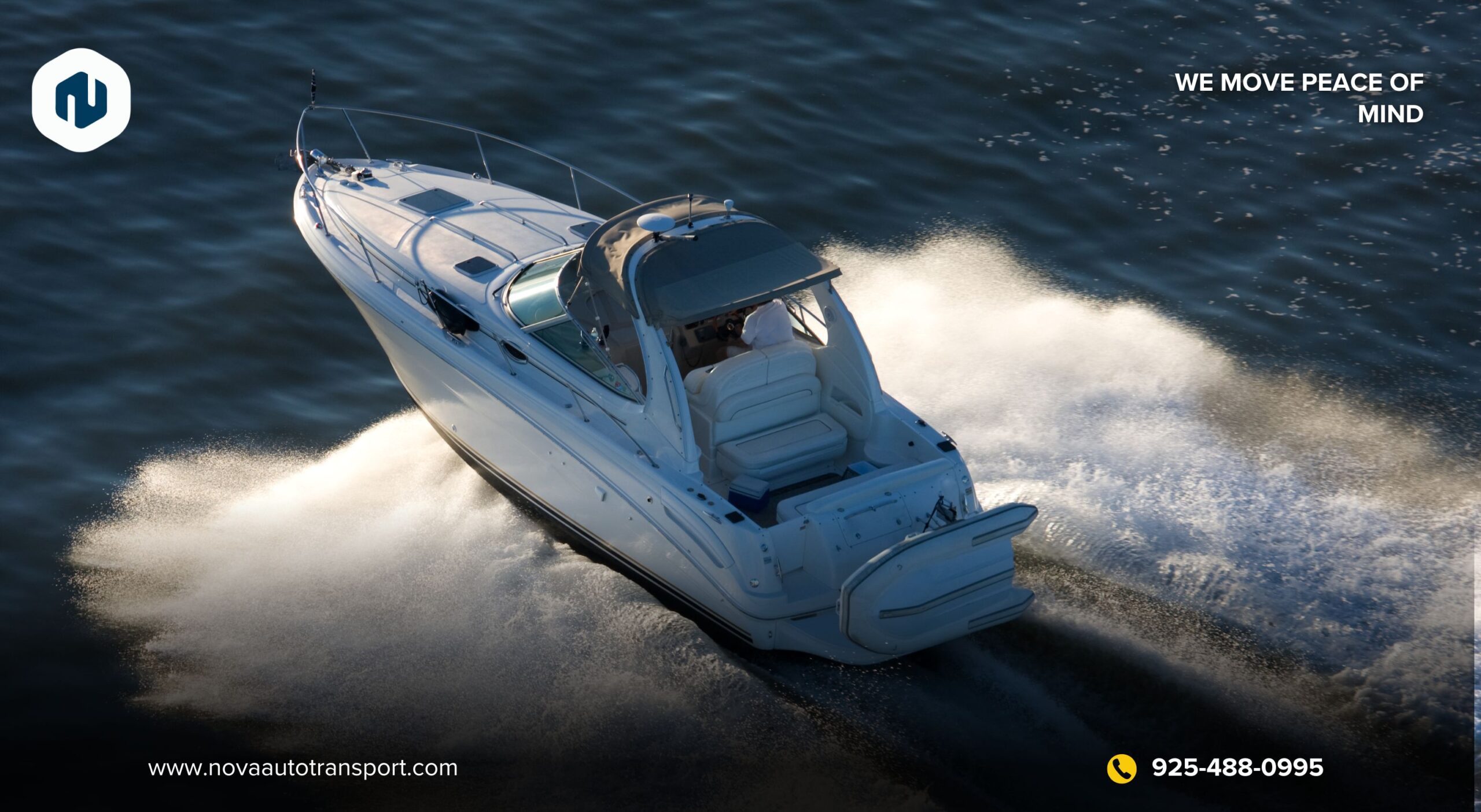
Cross-country is where things get pricey. Coast-to-coast (California to Florida) for a mid-size boat is typically $3,500–$7,000. Larger yachts can exceed $10,000 once permits and escorts are included.
Why so high? You’re covering 2,500+ miles, paying multiple states’ oversize fees, fuel costs, tolls, and labor for 5 to 7 days.
| Route | Distance | Avg Cost (Small Boat) | Avg Cost (Large Boat) |
| LA to San Francisco | ~380 miles | $600–$1,000 | $1,000–$1,600 |
| Sacramento to San Diego | ~500 miles | $800–$1,200 | $1,200–$2,000 |
| California to Texas | ~1,500 miles | $2,000–$3,200 | $3,500–$5,500 |
| California to Florida | ~2,500 miles | $3,500–$7,000 | $6,000–$10,000 |
Key Takeaway
If you’re only moving within state lines, expect a few hundred to a grand. But cross-country? Budget in the thousands, and always get quotes early to avoid seasonal price spikes.
Popular Routes & Cost Examples (With Numbers)
Some boat shipping routes are more common than others, and that means carriers can offer better pricing due to demand. Others are less traveled, making them more expensive.
Florida Routes
The approximate 280-mile trip from Miami to Tampa costs $700 to $1,100 for small boats and $1,200 to $2,000 for large yachts.
About 350 miles from Miami to Jacksonville: $800–1,300 | $1,400–2,200.
Because of its boating culture and snowbirds, Florida is the U.S. capital of boat transportation. Prices rise 15–25% due to seasonal demand (fall + spring).
California Routes
- LA to San Francisco (~380 miles): $600–$1,000 | $1,200–$1,600.
- San Diego to Sacramento (~500 miles): $800–$1,200 | $1,500–$2,200.
California’s strict oversize rules make costs slightly higher than other states. CHP enforces escorts tightly for loads wider than 12 feet.
Midwest Routes
- Chicago to Great Lakes marinas (~150 miles): $500–$800 | $900–$1,400.
- Chicago to Houston (~1,080 miles): $1,500–$2,200 | $2,800–$4,000.
Great Lakes routes are cheaper in summer when marinas are open longer hours. Winter shipping is tougher because of ice closures.
Cross-Country Routes
- New York to Miami (~1,280 miles): $1,800–$2,600 | $3,000–$4,800.
- California to Texas (~1,500 miles): $2,000–$3,200 | $3,500–$5,500.
- California to Florida (~2,500 miles): $3,500–$7,000 | $6,000–$10,000.
Fun fact: According to 2025 DOT stats, California to Florida is the #1 long-haul boat shipping lane in the U.S., making up nearly 18% of all oversized boat transports.
How to Save Money on Boat Transport
It is not cheap to have boats hauled, but it is possible to reduce the costs without compromising on safety.
Book in Advance
Bookings made at the last minute are practically always expensive. Discounts are available to book 3-4 weeks early, particularly when it is not high season.
Ship Off-Season
Spring and summer = most expensive. The demand is lower in late fall and winter, and you can get a 10-20% discount on the same route.
Be Flexible with Pickup and Delivery
Provided that you can permit a broader pickup window (3-5 days rather than 1), carriers might be able to provide a better price as they can bundle loads.
Compare Quotes
Do not take the first quote. Utilize transport markets or seek bids with several carriers. Other sites allow the carriers to compete against one another, and you can save hundreds.
Open vs Enclosed
Open transport is less expensive to boats of suitable size. The enclosed trailers are weatherproof and may cost 3040 percent higher.
Join Snowbird Caravans
When you are shipping Florida routes in the fall, request about grouped shipment discounts. When carriers are transporting several boats in the same lane, they tend to save money.
Pro Tip: It is always good to check what is included in the quote, permits, insurance, loading/unloading. Cheap quote may turn out to be costly in the future due to hidden charges.
How Boat Transport Works
So how does the actual process of boat shipping work? It’s not as simple as “call a truck and load it.” There’s rules, inspections, scheduling, paperwork, and safety checks that all happen in order. If you’ve never done it before, the first time can feel overwhelming. But breaking it down step by step makes it easier to follow.
Step 1: Request a Quote
It all begins with a quote. The carriers will request you to provide the size of the boat (length, beam, height), weight, pickup, and delivery address. They will also inquire whether the boat is on a trailer, in a marina, or on blocks. The more precise the price is, the more precise you will be. A 20 ft center console on trailer can be quoted at around 1,000 miles over 500 miles, and a 40 ft sailboat with no trailer may be quoted at 3,500 miles over 500 miles.
Step 2: Measure & Prepare the Boat
Most mistakes happen here. If the boat is even 6 inches wider or taller than you reported, the carrier might not be able to haul it legally. Federal law limits height at 13’6” and width at 8’6” before permits are needed. Always measure beam with mirrors, radar arches, and rails included. Carriers often ask for pictures too.
Step 3: Schedule Pickup
Once you book, the carrier gives you a pickup window, usually 2–5 days. They’ll coordinate with marinas if special equipment like a travel lift is required. Expect marina lift fees of $200–$500.
Step 4: Loading & Inspection
At pickup, the boat is inspected, photos taken, and a Bill of Lading (BOL) is signed. This document is like the boat’s travel passport, it notes the condition before loading and again at delivery. Any damages have to be noted here for insurance claims.
Step 5: Transport & Tracking
Your boat is hauled using a flatbed, lowboy trailer, or tow-away setup. Most carriers now provide GPS tracking or at least call/text updates. Cross-country trips can take 5–7 days depending on weather and permits.
Step 6: Delivery & Final Inspection
Upon arrival of the boat, it is unloaded via a travel lift or forklift (unless on a trailer). Check thoroughly, compare with the BOL photos, and report any problems on the spot. The time within which insurance claims must be filed is normally 48 hours.
Pro Tip: it is always good to have a copy of permits and the DOT number of the driver. Legal interstate hauling needs the FMCSA licensing.
Prepare Your Boat for Transport (Checklist)
Prep is another aspect of boat shipping that is underestimated. An ill-equipped boat may cause losses, time wastage or additional expenses. Boats are even sometimes rejected by carriers when not tied down. The following is a complete list of things that any boat owner must make a checklist before transportation.
Drain & Clean
- Empty out drain fuel and water tanks to 1/4 or less. This is essential to many carriers.
- Pump out holding tanks.
- De-bilge all standing water.
Secure & Protect
- Bring or tie down loose gear such as cushions, electronics, fishing rods, dinghies.
- Close hatches with tape.
- Use a shrink wrap or shielding material to cover the windshields in order to avoid road debris damage.
Disconnect Power
- Disconnect batteries and cable-tie.
- Remove propane tanks. Propane will not be transported by most of the carriers.
Height Reduction
- Eliminate masts, antennas, radar arches, or flybridges, where possible. Boats greater than 13 feet 6 inches need permits and in some cases escort vehicles, which incur huge expenses.
Documentation
- Prior to pickup, take pictures of all angles of your boat.
- You should have a copy of your insurance policy.
- In case necessary, have a marine surveyor examine the vessel.
Marina Coordination
- Check crane/lift times with marina personnel. Most marinas will charge on a per hour basis in case the driver is forced to wait.
Owners who don’t prep right often pay more. According to BoatUS, about 20% of transport delays in 2024 were due to improper prep, like boats showing up with loose gear or oversized antennas.
Insurance & Safety Considerations
Insurance is the boat transport safety net, and most owners are unaware of what is covered. They think that oh the carrier is insured, I am ok. However, not all policies are the same and failure to read the fine print can make you pay thousands in case something goes wrong.
Carrier Insurance Basics
The liability insurance that most professional haulers have is $100,000 – $250,000 per load. This includes simple damages that occur in loading, hauling, or unloading. However, when the value of your boat is $500,000, you will need more than that insurance.
Cargo Insurance & Add-Ons
Ask a carrier whether they are providing cargo insurance or you need to get a rider. Other owners do it through their marine insurers and contain a transport clause. They have different prices, although there is usually an extra cost of 200-500 on larger boats.
Bill of Lading Importance
Always examine the Bill of Lading. In case it does not include the presence of previously existing scratches or dings, it is crucial to note them down. Otherwise, the carrier may complain in the future that the damage existed initially.
State & Federal Safety Rules
Carriers must follow DOT and FMCSA safety regulations. Oversized loads require:
- “Oversize Load” signs on truck front & back.
- Safety flags on the corners of the load.
- Escort vehicles if over 12 ft wide (requirements vary by state).
- Permits for each state where the load crosses.
It is dangerous to skip the permits, in 2023, DOT cited more than 500 times of illegal hauls of oversize boats, with a fine of up to $5,000 each.
Bottom line: Don’t assume. Request your carrier to provide evidence of insurance, permits and licensing. Nova Auto Transport will only collaborate with FMCSA-certified, insured haulers to save your boat and your wallet.
Case Study (Trust-Building)
A real example is sometimes the best way to see what is going on. Here is one off the road.
San Diego to Seattle (2024)
One of the customers had to transport a thirty-foot yacht 1,250 miles between San Diego, California and Seattle, Washington.
- The boat is 30 feet (10 feet) long, 11 feet (11 feet) high in beam.
- Permits: California and Oregon have an oversize permit on beams above 8-6.
- Where the beam is less than 12 feet, escort vehicles are not necessary.
- Insurance: As the carrier added a customer, it increased by 250,000 the liability and added 300 marine insurance riders.
- 2 Prep Work: Take off radar arch and cover the boat with shrink wrap.
Prices
- Transport base rate: $3,800
- CA and OR permits: a total of $120
- $400 for marina lift fees (pickup + delivery)
- Additional insurance: $300
- $4,620 in total
Timetable
- Pickup: Monday after loading and inspection.
- 6 days for transit (weather delays in Oregon).
- Delivery: Seattle Marina on Sunday.
- Findings
Results
The boat arrived safely, no damages. Customer said the process was “much smoother than expected” because Nova Auto Transport handled all permits and coordinated with marinas ahead of time.
Case studies like this show the hidden fees people forget. Permits, lifts, insurance add-ons, they all add up. But when properly planned, the move goes stress-free.
Frequently Asked Questions
How much does it cost per mile to transport a boat?
On average in 2025, transporting a boat costs between $1.50 and $3.75 per mile depending on size, route, and season. Small boats on trailers are cheaper, while yachts and oversize loads cost more because of permits and escorts. For example, a 200-mile trip for a fishing boat may only be $600, but a 1,000-mile haul for a 12-foot beam yacht can go over $4,000. Prices also change with fuel rates, tolls, and even traffic. Always ask carriers for a written per-mile estimate and confirm if permits or lift fees are included so you don’t get surprised at delivery.
Is it cheaper to ship by land or sea?
It really depends on distance and type of vessel. Land shipping is almost always cheaper for in-state or regional trips under 1,000 miles, because it avoids docking, crane, and international port fees. But if you’re moving your boat across oceans (like New York to Europe or California to Hawaii), then shipping by sea is the only option. Sea transport can be done in containers, cradles, or by roll-on/roll-off, but it adds customs and port charges. A 25-foot boat from Florida to the Bahamas might be $2,500, while trucking the same boat 500 miles inland could cost less than $1,500.
Do I need a permit for oversized boats?
Yes, and this is where it can creep in expenses. The United States has a maximum beam (width) requirement of 8 feet 6 inches (overweight boats require a permit). Those heights over 13 feet 6 inches also leads to extra permits and in certain instances, escort vehicles. The charges are different across the states with California charges usually between 20-35 dollars per trip and Texas more like 60. In case of very broad boats (over 12 feet beam), however, pilot cars may be required, too, at a rate of $1 2 per mile. This is typically established by carriers, however, you are the bill payer. The consequences of not taking permits can be massive fines and even impounded ships.
What is the cheapest way to transport a boat?
The least expensive option is where your boat is small enough to be on its own trailer. You can get a tow-away service, in which a carrier attaches your trailer and tows it. Prices begin at approximately 1 dollar per mile on light boats and that is less expensive compared to flatbed hauling. In the case of medium-size boats, open overland transport is less expensive than enclosed or sea shipping. It all comes down to flexibility the secret to saving money: reserve during the off-season (late fall/winter), share routes with other boats, and shop around with other carriers. As uShip data show, in 2024, customers who have used competitive bidding saved approximately 22% of the amount they would have saved by taking the first offer.
Can I ship a boat internationally?
Yes, thousands of boats ship overseas every year, but the process is more complex than moving within the U.S. Boats can go by container shipping (if under 40 ft), flat rack for oversized yachts, or roll-on/roll-off (RORO) for trailerable vessels. Costs vary hugely: Florida to Europe may be $8,000–$15,000, while West Coast to Australia can top $20,000, depending on size. You also have to factor in customs clearance, port handling, and marine insurance. International boat shipping often takes weeks instead of days, so planning is key. Always work with licensed international shippers who understand both U.S. Coast Guard and foreign port regulations.
Are You Ready to Get Your Boat Transported?
So, what’s the bottom line on boat transport costs in 2025? You’re usually looking at $1.50–$3.75 per mile, with short in-state hauls starting around $400–$800 and long cross-country moves hitting anywhere from $3,500 to $7,000+ for larger vessels. The prices vary depending on the size and shape of your boat, the route, permissions, fuel, marina lifts, and even the season of the year that you choose to move it.
We have been shown actual instances, such as that of a 30-foot yacht relocated between San Diego and Seattle, for $4,620, where the permits, insurance riders, and marina charges all accumulated. That is why preparation, including emptiness of tanks up to the correct measurement of the beam, is the key to avoiding any hidden costs.
The safest way to move your boat is always with a licensed, insured, FMCSA-compliant hauler, not a backdoor operator. And sometimes, if you’re moving boats alongside vehicles, working with a transport company like Nova Auto Transport gives you bundled pricing and peace of mind.
Ready to plan your move? Get a Free Boat Shipping Quote Today and lock in guaranteed pricing with Nova Auto Transport, because your boat deserves more than just a guess on cost.


